Explore how Indigenous communities reclaim language as identity, governance, and sovereignty—reviving culture through education, technology, and self-determination.
![(Prince of Wales' visit to Canada) A chat with Indians at Government House Victoria, [B.C.] Sept. 23-28, 1919](/images/signature-collections/firstnations_leaders1919_800.webp)
(Prince of Wales’ visit to Canada) A chat with Indians at Government House Victoria, [B.C.] Sept. 23-28, 1919
Language Sovereignty: Defending the Right to Speak, Teach, and Preserve Indigenous Languages (Land Back - Part 2 of 4)
Language is more than just a tool for communication. For Indigenous communities, it is the foundation of identity, governance, and self-determination. Language sovereignty is the right to decide how languages are spoken, taught, and passed down—without external interference. But just as land was taken, so too were languages suppressed. Colonial policies intentionally targeted Indigenous languages, forcing replacement with dominant colonial languages.
Today, Indigenous nations are reclaiming their languages through education, technology, and governance, ensuring that future generations can speak and live their heritage on their terms.
Language is power. This is why language sovereignty is a critical part of the broader fight for Indigenous rights.
What is Language Sovereignty?
Language sovereignty means that Indigenous nations hold full authority over how their languages are used, taught, and preserved. It’s about ensuring that language revitalization is led by Indigenous communities and not dictated by outside governments or institutions.
- International Language Rights: The UN Declaration on the Rights of Indigenous Peoples (UNDRIP) states:
“Indigenous peoples have the right to revitalize, use, develop, and transmit to future generations their languages, oral traditions, writing systems, and literatures. States shall take effective measures to protect these rights, including through interpretation in political, legal, and administrative proceedings.”
- The Declaration on the Rights of Persons Belonging to Minorities (1992) protects language use from interference or discrimination.
Language sovereignty ensures that Indigenous languages remain in the hands of the people who have spoken them for generations. It is about autonomy, dignity, and the survival of cultural knowledge.
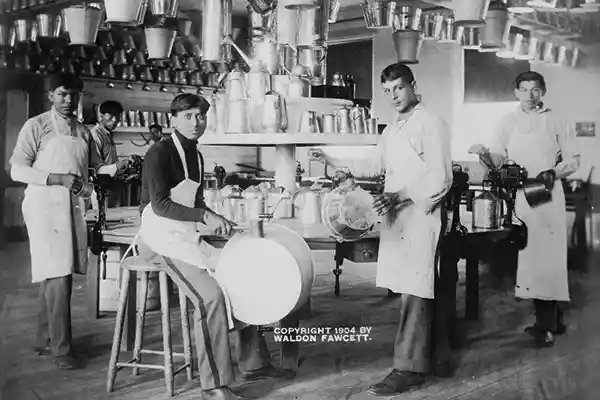
Young Native American men in metalworking workshop with pails, washtubs, watering cans, and other metal items. c1904
Colonization and the Loss of Indigenous Languages
Indigenous languages did not simply “fade away”—they were actively suppressed.
- Boarding and Residential Schools: Indigenous children were punished for speaking their languages, severing intergenerational transmission.
- Legal Bans on Indigenous Governance and Ceremonies: Many Indigenous governance systems and spiritual practices—often conducted in Indigenous languages—were outlawed.
- Underfunding of Indigenous Education: Even today, many Indigenous schools lack resources for language immersion programs, leaving communities struggling to revitalize their languages.
Colonialism didn’t just take land; it took languages. But Indigenous communities are fighting back.
Reclaiming Language Sovereignty: Paths to Revitalization
1. Community-Led Language Immersion Programs
True language revitalization happens when languages are used in everyday life. Community-led immersion programs ensure that Indigenous languages are spoken at home, in schools, and on the land.
Example: Dene Nahjo (Denendeh)
Dene Nahjo runs land-based language camps where youth learn the Dene language through traditional practices like hide tanning and storytelling.
These programs reconnect Language with land, reinforcing the deep ties between Indigenous knowledge, culture, and governance.
2. Technology as a Tool for Language Sovereignty
Digital platforms and tools are revolutionizing Indigenous language learning, making it easier to access learning materials anytime, anywhere. But technology must be built with Indigenous control at its core.
Example: Languages 4®
- Uses advanced speech recognition to improve pronunciation.
- Features Augmented Reality (AR) for immersive, culturally relevant language learning.
- Offers cloud-based, cross-platform access, ensuring language materials are always available.
- Guarantees that Indigenous communities retain full ownership over their language data.
Indigenous communities should never have to ask permission to access their languages. Technology should empower, not control.
3. Revitalizing Indigenous Governance in Indigenous Languages
Language sovereignty isn’t just about communication; it’s about governance. When Indigenous languages are used in leadership and legal systems, they become languages of power.
Example: The Mohawk Nation of Kahnawà:ke
The Mohawk Nation conducts governance meetings in Mohawk, ensuring that political and legal discussions happen in their ancestral Language. When Indigenous languages are spoken in law, policy, and everyday governance, they thrive as languages of power—not just languages of the past.
Final Thought
Reclaiming Language means reclaiming sovereignty. It means ensuring that Indigenous nations—not outside institutions—decide how their languages survive and thrive.
By leading language immersion programs, leveraging technology, and integrating Indigenous languages into governance, Indigenous communities are reclaiming their identity
Language sovereignty is not just about preserving words—it’s about ensuring that Indigenous peoples can live, govern, and dream in their languages again.
Next in the series: “Land as the First Classroom: How Language and Ecology Are One.”
Language is more than words. It is identity, land, and power. And Indigenous nations are reclaiming all three.
📚 References
-
United Nations
Indigenous Languages – Vitality, Endangerment, and Revitalization.
United Nations Department of Economic and Social Affairs (UN DESA), 2018.
https://www.un.org/development/desa/indigenouspeoples/wp-content/uploads/sites/19/2018/04/Indigenous-Languages.pdf -
Yellowhead Institute / Dene Nahjo
Land, Life and Culture in Denendeh: Making Connections with Dene Nahjo.
Yellowhead Institute, 7 Jan 2020.
https://yellowheadinstitute.org/2020/01/07/land-life-and-culture-in-denendeh-making-connections-with-dene-nahjo/ -
Mohawk Council of Kahnawà:ke
Council Communiqué – Monday, 20 Tsothohrhkó:wa (January) 2025.
Kahnawà:ke Mohawk Nation.
https://kahnawake.com/council-communique-monday-20-tsothohrhkowa-january-2025/
Connect With Us
Follow our journey, share your thoughts, and participate in the conversation. Let’s keep languages vibrant together.
Languages 4™ is more than a tool; it’s a partner in the mission of preserving and revitalizing Indigenous languages. We invite you to reach out to us and explore how our platform can support your language teaching goals. [Join the Conversation 📩 Subscribe to our Newsletter ] and take a step towards sustaining the rich heritage of Indigenous languages.
Tagged:
By Tim O'Hagan
Related Articles

Land Back & Indigenous Language Revitalization | Reclaiming Culture & Identity
Explore how the Land Back movement empowers Indigenous language revitalization, reclaiming culture and identity. Learn how land justice shapes sovereignty.
Land as the First Classroom: How Language and Ecology Are One
Explore the deep connections between Indigenous languages and ecological knowledge, highlighting the Gwich’in and W̱SÁNEĆ Nations' efforts in language revitalization through land-based learning.

Building the Future: Indigenous-Led Land Back Success Stories
This article explores how returned Indigenous lands are being used to revitalize language, restore governance, and rebuild culture, with success stories from the Winnebago, Salish-Kootenai, and Yurok Nations.